Tuesday, September 6, 2016

Gingivitis: What Is It & How To Deal With It

Gingivitis: What Is It & How To Deal With It


Gingivitis is a term that is used quite frequently in dental offices and which is diagnosed to millions of Canadians each year. You probably know that it is something you don’t want to have, but do you really know what gingivitis is and why it happens? What happens once you have gingivitis, and what can be done about it?

What is Gingivitis?

Believe it or not, gingivitis sounds much worse than it really is. Essentially, gingivitis refers to the inflammation of the gums. This inflammation is caused by built up plaque and the bacteria it contains, which naturally form on your teeth every day and is the reason why we recommend brushing your teeth and flossing each day.
Gingivitis can cause your gums to become red, swollen, and often causes bleeding. Generally, gingivitis is not painful, but be on the lookout for early warning signs such as blood on your toothbrush or bleeding gums when you floss. If steps are taken to address gingivitis during the early stages, it can be reversed fairly easily.

How Did I Get Gingivitis?

Gingivitis occurs in areas of the mouth that are not properly cleaned daily. This usually happens behind the four back molars where it can be uncomfortable to floss and brush because it is much closer to the throat. Gingivitis also happens near the gumline on both the top and bottom teeth where it is commonly not cleaned properly. The lack of proper cleaning of plaque in these and other areas of the mouth is how gingivitis starts and the places to pay particular attention to when cleaning your teeth.

How Do I Treat Gingivitis?

If in the early stages, treating gingivitis is fairly easy and consists of brushing twice every day, including the tongue, cheeks, and roof of the mouth, and, ideally flossing at least once. Be sure to use a soft bristled toothbrush so as to not aggravate the gums unnecessarily, and ensure that you are cleaning between teeth and at the gum level to properly get rid of plaque before it hardens into tartar.
If you continue to ensure that plaque is removed properly every day and that the gums are stimulated through brushing and flossing, the early stages of gingivitis should soon reverse. When your gums return to a pink colour, and are no longer puffy and no longer prone to bleeding, you will know that your gums are healthy and happy again.

What Happens if Gingivitis is Left Untreated?

If the early signs of gingivitis are not noticed or are ignored, gingivitis can quickly progress into gum disease. This happens if plaque is not removed from teeth and it hardens into tartar, a substance that can only be removed professionally.
Once tartar lines the gums, infection can happen and from there major dental issues such as flesh, bone, and tooth loss can become a reality. Gingivitis causes the gums to loosen and pull away from the teeth, causing teeth to become loose and hastening gum disease. While the very early stages of gingivitis are not something to necessarily panic about as it can be treated, it is absolutely not something that should go unattended or brushed off.

How Do I Prevent Gingivitis?

Prevention is key in keeping your oral health at its best, and regular dental checkups at least every six months are the best way to ensure that your teeth are being properly cleaned. Missing even one dental cleaning can lead to a flare up of gingivitis.
Be sure to take the time in the morning and before bed to care for your mouth. This includes about two minutes of brushing all sides of teeth, tongue, cheeks, and the roof of the mouth, and flossing between all teeth.
Mouthwash is a great extra step to take in ensuring that all areas of your mouth are cleaned and cared for, but we would recommend using one that is alcohol-free since those can dry things out and cause other problems. It is essential to know that pain is not a symptom of gingivitis, so being on the lookout for the other symptoms is key to prevention.
Make an appointment by calling 0925-567-5329 • 0908-865-5662 • 0917-566-1932 • 458-0717 and schedule a consultation today.

Visit us at BRITANNIA MEDICAL CENTER - The Enclave
Enclave Complex, Fil-Am Friendship Road, Angeles City.
britanniamed@gmail.com || www.britanniamedicalcenter.ph || britanniamedicalcenter.blogspot.com



Monday, September 5, 2016

What Is Fluoride And Do You Really Need It?

What Is Fluoride And Do You Really Need It?


What is fluoride exactly?

Fluoride (often misspelled as Flouride) is a colourless, naturally-occurring mineral that can be found throughout the Earth’s surface. It can be found in solid, liquid and gas forms and, when applied in small doses, has been proven to strengthen teeth and prevent tooth decay. It’s for this reason that fluoride is often added in very small doses to the drinking water of municipalities as it has been proven to prevent cavities when compared to areas without fluoridated drinking water.
If you have been to your dentist lately for a routine dental checkup, you likely experienced a concentrated fluoride treatment which usually comes in the form of a flavoured foam and is applied to your teeth using dental trays. What’s your favourite flavour?

How does fluoride protect my teeth?

Fluoride protects teeth in a few different ways. One way is by strengthening the structure of the tooth for small children who are under seven years of age, which is still in the developmental stages for their teeth enamel. If the right amount of fluoride is applied during this period, the actual structure of the enamel is strengthened and becomes more resistant to acids. This means that, as the child grows, they will have teeth that are better protected right from the beginning.
When plaque builds up on and around teeth, the destructive bacteria within it is in direct contact with the enamel of the teeth. The bacteria slowly eats away at the enamel and weakens it by leaching vital minerals out of it. This process is called demineralization and, while the mouth naturally fixes the weakened enamel through remineralization, the natural process can become ineffective if teeth are not cleaned properly or if too much sugar enters the mouth on a regular basis.
So another way that fluoride helps to protect teeth is through remineralization. Fluoride helps to promote the process of remineralization and makes sure that the enamel which is replaced during the process is stronger and less susceptible to breakdown.
Fluoride also works against the destructive acid produced by plaque which is extremely important in preventing tooth decay. It does this by blocking some of the most harmful enzymes found in plaque and prevents them from producing the acid that weakens tooth enamel.
There have been studies that have shown how fluoride may play a further role in the development of children’s teeth. In children who consumed the suggested amount of fluoride, the grooves in their teeth, also known as fissures, were much shallower than those found in the teeth of children who did not have fluoride in their diet. Shallower fissures mean that it is less likely that food particles and harmful bacteria will get stuck in the crevices and pits in the teeth that are difficult to clean. This can result in fewer cavities and a healthier mouth overall.

How can I make sure I’m getting enough fluoride?

The most effective way to ensure that you are introducing fluoride into your mouth, and one of the most important steps in general oral care, is to brush your teeth twice each day with fluoridated toothpaste. Make sure that when you are brushing, you take the time to go over and around each tooth on all sides and along the gum line to ensure that you aren’t leaving any area uncleaned or unprotected.
Make an appointment by calling 0925-567-5329 • 0908-865-5662 • 0917-566-1932 • 458-0717 and schedule a consultation today.

Visit us at BRITANNIA MEDICAL CENTER - The Enclave
Enclave Complex, Fil-Am Friendship Road, Angeles City.
britanniamed@gmail.com || www.britanniamedicalcenter.ph || britanniamedicalcenter.blogspot.com


Sunday, September 4, 2016

What Are Canker Sores?

What Are Canker Sores?


If you have ever experienced a canker – or chancre – sore in your mouth, you know that they can be bothersome at the very least, and often quite painful. They seem to pop up out of the blue and immediately outstay their welcome. So, what are they exactly, and is there anything you can do to get rid of them?
Read on to discover everything you need to know about canker sores.
Canker sores are generally small ulcers found only inside the mouth, usually along the cheeks, tongue, or lips. They can make it very uncomfortable to talk, eat, or drink and can be very painful when acidic foods come into contact with them. The flesh of the sore itself is usually white and very tender with red aggravated skin surrounding it, but they are not contagious.

Who do canker sores affect?

Women are twice as likely to get canker sores than men and usually occur between the ages of 10 and 20, although they can appear earlier in life. That being said, anyone can be affected by canker sores at any age. There have been cases of canker sores reported as early as two years old.

What causes canker sores?

Unfortunately, the true cause of canker sores is unknown. However, it has been proven that eating an excess of highly citrus fruits, such as lemons, oranges, pineapples, tomatoes, and strawberries, can trigger canker sores in many people.
Consuming a lot of sugary foods, such as candies, can also cause sores to pop up. Damage or irritation from dental appliances, accidental biting of the tongue or cheek, or ill-fitting dentures can also be a trigger for canker sores. There has also been evidence that suggests a diet lacking in vitamin B-12 can cause canker sores. This vitamin can be found in foods such as eggs, dairy products, and seafood.

What is the difference between a canker sore and a cold sore?

Canker sores occur exclusively inside the mouth and do not have any known cause. Cold sores, on the other hand, are caused by a viral infection and are highly contagious. Unlike canker sores, cold sores occur outside of the mouth and are filled with fluid, resembling blisters, and generally scab over before healing.

Are canker sores dangerous?

Generally, no, canker sores are not dangerous. They can be extremely uncomfortable, even very painful, but they usually disappear on their own after a week or two. However, canker sores should not occur more than four or five times in a year – so if you experience an excessive amount, it could point to a larger health issue. Consult your doctor if you believe this sounds like your experience.

How do you treat a canker sore?

Canker sores can also be laser treated by your dentist which provides immediate relief and quicker healing time. If you are bothered by canker sores regularly, your dentist may recommend that you use a canker sore combating mouthwash.
Avoiding trigger foods, such as highly citrus fruits and extremely sugary treats, is essential when letting your canker sore heal as exposing it to these foods can further aggravate it. Being careful when using dental appliances such as retainers, dentures, and braces, is important to ensure further damage isn’t done to the affected area.
Be sure to thoroughly brush your teeth after meals to ensure that food particles or bacteria doesn’t get attached to the sore and possibly cause an infection. If your canker sore does not improve on it’s own after two weeks, consult your dentist or doctor for further diagnosis.
Make an appointment by calling 0925-567-5329 • 0908-865-5662 • 0917-566-1932 • 458-0717 and schedule a consultation today.

Visit us at BRITANNIA MEDICAL CENTER - The Enclave
Enclave Complex, Fil-Am Friendship Road, Angeles City.
britanniamed@gmail.com || www.britanniamedicalcenter.ph || britanniamedicalcenter.blogspot.com


Thursday, September 1, 2016

How much do you know about your wisdom teeth?

How much do you know about your wisdom teeth?


Why do you have wisdom teeth?

Anthropologists believe that wisdom teeth were an evolutionary development that were required by our ancestors. It is thought that they needed these extra molars to help chew and digest their diet of rough foods.
A typical adult can have up to 32 teeth. Most of these develop when you are a child however the wisdom teeth (third molars) will appear when you are older; usually when you are between the ages of 17 and 25, although they can appear when you are younger or older than that as well. It is often the case that people do not have room for a full set of 32 teeth. A typical person will have room for around 28 teeth and so the development of wisdom teeth can cause difficulties when they push through the gum.

Do you need to have your wisdom teeth removed?

It is not mandatory to have your wisdom removed. If your mouth has enough room they will be able to push through your gums and will not cause you any problems. It is also common for wisdom teeth not to push through the gum at all and can simply shift underneath the gum. You may experience some discomfort as wisdom teeth move into position, below or through the gum, but once the tooth is in its position this discomfort should disappear.
In the past it was more common for dentists to remove wisdom. Nowadays it is generally agreed that if your wisdom teeth are not causing any problems or discomfort they will be left intact. If however your wisdom teeth are causing pain or discomfort or decay then your dentist may decide it is best to remove them.

What are impacted wisdom teeth?

If your wisdom tooth is stuck against an adjacent tooth your wisdom tooth is said to be impacted. This occurs when a wisdom tooth attempts to push through the gum even when there is not enough room in your mouth. This can cause the wisdom tooth to come in at an angle and put pressure on the tooth beside it.
Your impacted wisdom tooth can be fully or partially impacted. A fully impacted wisdom tooth is one that has not broken through the gums. A partially impacted wisdom tooth is one that has slightly erupted (broken through the gum). There are four types of impacted wisdom teeth depending on the angle they are affecting your mouth:
  • Distoangular Impaction occurs when the wisdom tooth tilts backwards.
  • Vertical Impaction occurs when the wisdom tooth has no tilt.
  • Mesioangular Impaction occurs when the tooth is tilted forward. This is the most common form of tooth impaction.
  • Horizontal Impaction occurs when the wisdom tooth is tilted horizontally.
Impacted wisdom teeth can cause problems to your dental health. They can damage your other teeth, cause cysts and because they are generally harder to clean can lead to tooth decay and gum disease.

How are impacted wisdom teeth treated?

If your wisdom tooth is causing pain or decay then your dentist may suggest that you have the problem tooth removed. The difficulty of removing your wisdom tooth depends on the shape of the roots and the position of the tooth. You dentist will be able to use x-rays to examine the position of your wisdom tooth and advise you on the difficulty of removing it. It is generally easier to remove upper wisdom teeth than lower ones and the procedure may take place in your dental practice or you may be referred to a oral surgeon. A wisdom tooth extraction requires a local anaesthetic, like you would receive for a filling and you may experience numbness in your mouth until it wears off.

Teeth straightening by cosmetic dentists in Britannia - The Enclave

Unfortunately it can often be the case that developing wisdom teeth can push and shift the position of your teeth, making them crooked or overlapped. If you feel that your smile is not as straight as it used to be then you may be interested in orthodontic treatments which can help straighten and improve your smile. Developments in dentistry have introduced a number of different discrete braces that can help straighten your smile without people noticing.
Orthodontic treatments can also be given in coordination with other dental procedures to give you a full Smile Makeover. Dental advancements have greatly improved the dental treatments available so there really is no need to suffer in silence, or feel embarassed about your smile. 

If you are interested in having a Smile Makeover, getting your teeth straightened or are concerned about impacted wisdom teeth then please contact the Britannia - The Enclave. Our experienced team will be happy to help advise you on treatments or book you in for a consultation in our warm and calming practice.
Make an appointment by calling 0925-567-5329 • 0908-865-5662 • 0917-566-1932 • 458-0717 and schedule a consultation today.

Visit us at BRITANNIA MEDICAL CENTER - The Enclave
Enclave Complex, Fil-Am Friendship Road, Angeles City.
britanniamed@gmail.com || www.britanniamedicalcenter.ph || britanniamedicalcenter.blogspot.com


Tuesday, August 30, 2016

Are your sinuses causing you toothache?

Are your sinuses causing you toothache?


How do my sinuses affect my teeth?

Sinuses are cavities in the skull which join up with the nasal passages and cheekbones. When we suffer from allergies or colds, these can become blocked, making us feel stuffy or causing difficulty breathing through the nose.

What causes sinus toothache?

Full sinuses exert pressure on the face, specifically on the back teeth of the upper jaw, which lie close to the sinuses. Inflammation of your sinuses could be a result of allergies, a cold or an underlying sinus infection.
Sinus toothache can occur during the summer or winter but it needs to be diagnosed by a dental professional.

What are the symptoms of sinus toothache?

Symptoms of sinus toothache include:
  • toothache in the upper back teeth
  • increased sensitivity to hot or cold
  • a throbbing sensation in the upper back gums and jaw tightness
They can be hard to distinguish from common toothache, but the following symptoms usually accompany sinus problems:
  • cold symptoms, such as a stuffy nose and sore throat
  • yellowish-green mucus
  • facial pain and headaches, specifically around the eyes and cheekbones
  • a bitter taste in the throat or mouth
  • earache

How do I treat sinus toothache?

If you’re suffering from any kind of toothache, make sure you book an appointment to see one of our Britannia - The enclave dentists. They will be able to check your mouth over and help determine whether the pain is indeed sinus toothache or a result of tooth decay or other underlying issues.
If you suspect you have sinus issues, you will also need to see your GP after your dentist has checked your teeth. Recurring or persistent symptoms could be a sign of a sinus infection, chronic sinusitis or an allergy, all of which require diagnosis by a doctor.
After diagnosis, your GP may prescribe over-the-counter decongestants, which restrict the blood flow to the sinuses and reduce pressure. Anti-inflammatories also help relieve the pain of sinus toothache while antihistamines should be used if your problems are related to allergies.
Most importantly, don’t suffer in silence!
Make an appointment by calling 0925-567-5329 • 0908-865-5662 • 0917-566-1932 • 458-0717 and schedule a consultation today.

Visit us at BRITANNIA MEDICAL CENTER - The Enclave
Enclave Complex, Fil-Am Friendship Road, Angeles City.
britanniamed@gmail.com || www.britanniamedicalcenter.ph || britanniamedicalcenter.blogspot.com


Friday, August 26, 2016

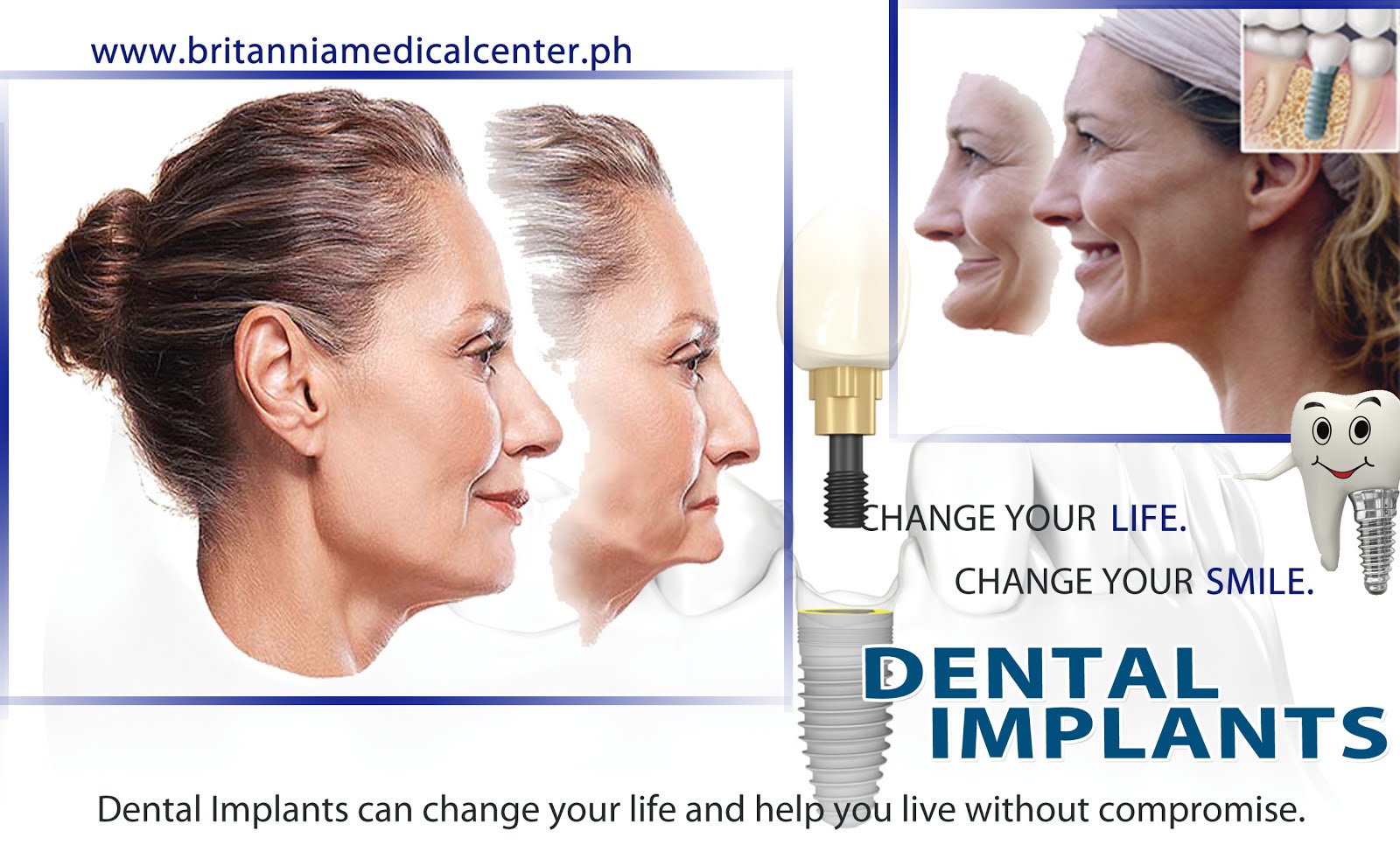
Dental implants can restore confidence in your smile

Dental implants can restore confidence in your smile


Not being able to smile properly due to lack of confidence can cause stress in social situations and make it difficult to interact with people properly. You may also find that daily tasks such as eating can be more painful with damaged teeth.
A dental implant from Britannia Medical Center - The Enclave could be the solution you are looking for to completely transform your life, allowing you to enjoy even the toughest of foods without hesitation and restoring confidence in your smile.

What are dental implants?

Dental implants are a cosmetic dentistry treatment that work by inserting an artificial tooth root into the jawbone. This tooth root is then used as a foundation to insert a bridge or crown which is visible above the gum line. They are designed to be fit in with your natural teeth and are the dental procedure that offer the closest option to restoring your own natural teeth. You may have lost or damaged teeth due to previous poor dental care or dental treatment. Alternatively you may be looking for a more permanent alternative or replacement to dentures. Dental implants provide a solution to all of these problems.

Dental implants allow you to enjoy your favourite foods

Precautions must be taken to ensure the transition goes smoothly after surgery. The most ideal way to conduct your dietary lifestyle for the first week after surgery is to stick to soft foods and carefully progress to harder and chewier foods afterwards. If you have damaged or missing teeth you may have been avoiding eating some of your favourite foods as they are too difficult or painful to chew. After a tooth implant, you will notice that after time the inside of your mouth feels relatively normal again, allowing you to be able to enjoy all of your favourite meals again.

Dental implants restore your confidence

Not only will dental implants make everyday tasks like eating more comfortable and enjoyable, but your appearance will also be significantly improved. Having a poor set of teeth can easily cause you to cover your mouth, shy away from photographs or avoid expressing happiness at all. It is easy to be embarrassed about your smile when your teeth are either deformed or missing, and this can have a negative effect on your self-esteem. Dental implants can provide an answer to this simple problem, allowing you to smile with confidence again.

Lifelong dental companions

Unlike bridges and dentures which need to be replaced every few years, dental implants are are a long term teeth replacement solution which will remain with you for life. Unlike dentures, dental implants will not slip around and they do not require augmenting healthy teeth, which is often required with dental bridges. Instead, they provide you with one of the most reliable, natural and easy to maintain dental solutions and can be treated as part of your existing dental hygiene routine.
Make an appointment by calling 0925-567-5329 • 0908-865-5662 • 0917-566-1932 • 458-0717 and schedule a consultation today.

Visit us at BRITANNIA MEDICAL CENTER - The Enclave
Enclave Complex, Fil-Am Friendship Road, Angeles City.
britanniamed@gmail.com || www.britanniamedicalcenter.ph || britanniamedicalcenter.blogspot.com

Wednesday, August 24, 2016

Sore throat, cough, fever: Is it a cold, the flu or strep throat?

Sore throat, cough, fever: Is it a cold, the flu or strep throat?


The common cold

The common cold is an upper respiratory illness, meaning that it affects the nose, throat and sinuses but not the lungs. It is caused by a virus. Although some people think colds are more common in the cold seasons, you can actually get a cold in any season. It is spread from person to person through hands, sneezing, or coughing.

What are the symptoms of a cold?

  • Sneezing
  • Stuffy nose
  • Runny nose
  • Sore throat
  • Cough
  • Low fever (100°F–101°F)
  • Headache
  • Feeling tired, achy and unwell

How long does a cold last?

  • Most colds last 3–10 days, but for some it will be as long as 2 weeks
  • Colds can last longer for smokers

Influenza, or the flu

Like the common cold, the flu is caused by a virus, but it’s a different kind of virus. It is more common beginning in October and ending in May (flu season). It can make you feel really terrible, and for some people it can cause serious problems. So what are you waiting for? Get a flu shot! You don’t need this kind of trouble in your life.

Symptoms

  • Fever higher than 100°F
  • Cough
  • Headache and body aches
  • Sometimes a sore throat and runny nose

How long does the flu last?

Most people feel better within 1–2 weeks.

Strep throat

Strep throat is an infection of your throat that is NOT caused by a virus, but by a bacteria called Group A Streptococcus. This is where antibiotics are helpful, because they are made to kill bacteria.

What are the symptoms of strep throat?

  • Sore throat, especially when swallowing
  • Fever higher than 100.4°F
  • Headache
  • Swollen glands in the sides of your neck
  • Feeling achy and unwell

When to call your doctor or get emergency help

  • Have trouble breathing or feel short of breath
  • Are drooling because you cannot swallow your saliva (spit)
  • Have swelling of the neck or tongue
  • Cannot move your neck or have trouble opening your mouth
Illnesses like cold, flu and strep throat can make the winter months a challenge. It helps is to take good care of yourself all year round, so when it’s time for your body to fight off an illness, it has the best possible chance of winning the fight as quickly as possible.
Make an appointment by calling 0925-567-5329 • 0908-865-5662 • 0917-566-1932 • 458-0717 and schedule a consultation today.

Visit us at BRITANNIA MEDICAL CENTER - The Enclave
Enclave Complex, Fil-Am Friendship Road, Angeles City.
britanniamed@gmail.com || www.britanniamedicalcenter.ph || britanniamedicalcenter.blogspot.com